
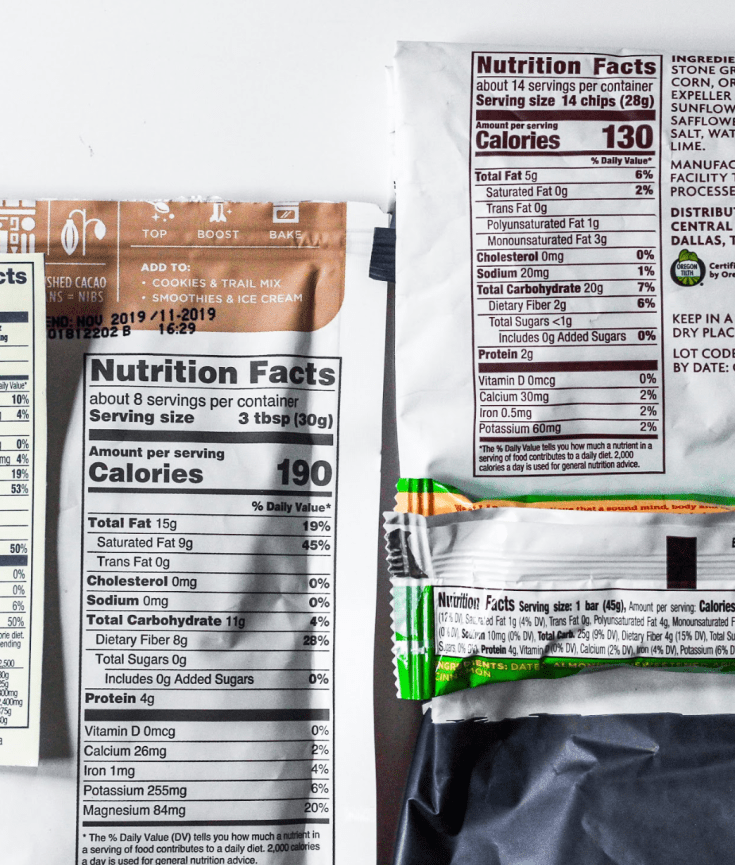
Food Label (noun): A panel found on a package of food which contains a variety of information about the nutritional value of the food item. Standard information on most food labels include serving size, number of calories, grams of fat, included nutrients, and a list of ingredients.
- As conscious consumers, it’s our responsibility to know what exactly it is we’re taking in.
- The same way you might look up an unknown word when reading a book or Googling a topic you didn’t understand in a recent news release, knowing how to understand and interpret food labels can make the act of consuming more conscious, deliberate, and indisputably your own.
- Each person prioritize certain aspects of a food label in different orders. While you may be interested in the fiber, your neighbor might check sodium. While the specific ingredients may have caught my eye, the man across the aisle checked the same label for calories.
- We are all different and have different needs. Instead of disregarding that and trying to push a “right” way of reading a label, I’m simply going to include a breakdown of each section.
Starting From The Top
1. Serving Size:
- So if we’re going to get the most out of our Label Reading Experience, we must understand that the numbers on the label are associated with one serving.
- Well, what’s a serving?
- In an attempt to provide a standard blueprint for each packaged food, the FDA reveals what they consider to be “one serving” at the top of each food label. The following daily values will be based off that one serving, but it’s necessary to understand that we are all different. A serving for you might be two for your kid. Or maybe you missed breakfast and need more than the recommended 12 crackers for your lunch. Regardless, tune into your own hunger cues and decide what serving size works for you.
2. Calories:
- Below the serving size will be the big and bold number of calories. For some, their eyes will stop here. Po-tay-toe, po-tah-toe, do your thing.
3. Daily (Recommended) Values:
- This is where you’ll find the percentage of whatever it is you’re investigating (fats, cholesterol, carbs, sodium, sugar, protein, etc) along the right hand side. If you google, “How To Read A Food Label,” this is where you’ll find several diagrams pointing out which are these categories are “good” and which are “bad.” However, I’d argue that this is another great opportunity to check these recommended values and reference them against your own personal needs:
- Are you diabetic?
- Do you have high cholesterol?
- Have you been trying to lower your salt intake?
- Use your own set of questions to assess whether the numbers you’re seeing work for you. And know that each dietary choice doesn’t have to be perfect.
4. Vitamins + Nutrients:
- Iron, magnesium, Vitamin A, K, D, and B, the list goes on and on. We need this variety of vitamins and minerals to keep our body’s properly functioning, however, when you’re consuming a balanced diet of whole foods, you’re probably getting your daily dose. By making an effort to eat fruits and vegetables you won’t need to rely on that whopping 4% of thiamin found in Lay’s potato chips to keep your metabolism working.
5. Ingredients:
- Ah, the bread and butter of nutrition labels, if you will. (I’m SO funny, c’mon). But actually, this is the section where you actually see what you’re eating. These listed items are what gives the packaged good a calorie count, a fat percentage, FLAVOR AND TASTE.
- When checking the ingredients, it’s important to know they they are listed chronologically by weight (with the highest weight first). This means whatever ingredient appears first is most likely the main ingredient. You may be surprised to find that some fan-favorite granola bars and cereals list their first ingredients as sugar. Though we knew these snacks tasted sweet, we probably didn’t expect the primary component to be King Cane (sugar) himself. But hey, the more ya know.
- For me, I try to find food labels that have a succinct ingredient list (I shoot for 8 or less) with only names that I can pronounce (hello, maltodextrin – the food additive I didn’t ask for).
- But, ONCE AGAIN, I can’t reiterate enough how each person is different.
Below I’ve included the Food Label for two different types of chips.
- The Classic Lay’s potato chip, which may get a bad rap in the “health realm” (what is the health realm? Am I in this? Sending out SOS’s) and…
- 2. A lentil-based chip.
- If you compare the nutrition facts, you’ll see they come out relatively equal.
- Lay’s has more calories, where Lentil Chip has more sodium.
- Lay’s provides 8% more of Vitamin C, where Lentil Chip has less fat.
- Both have short ingredient lists.
- Both supply very little protein.
- And both would satisfy a desire for a crunchy, salty snack.
- So, which do you pick?
- The Answer:
- Whichever one you you want.
- That’s the beauty in knowing how to read the labels.
- Buying and consuming isn’t about what the mass marketers are telling you to buy, it’s about what you want to buy.
- Filtering through the fads and media-worthy items, you can rely on yourself to decide what it is you want to buy.


- Packaging, flashy fonts, and big bold statements promising “heart healthy” and “nutrient-rich” may have played a part in what we bought and consumed before.
- But, now it’s time to discard that fluff.
- Decide for yourself what you want to eat.
- Buy what feels good to you.
- Buy what you care about.
- Because now, you’ve got the tools to do just that.
 the exhale